
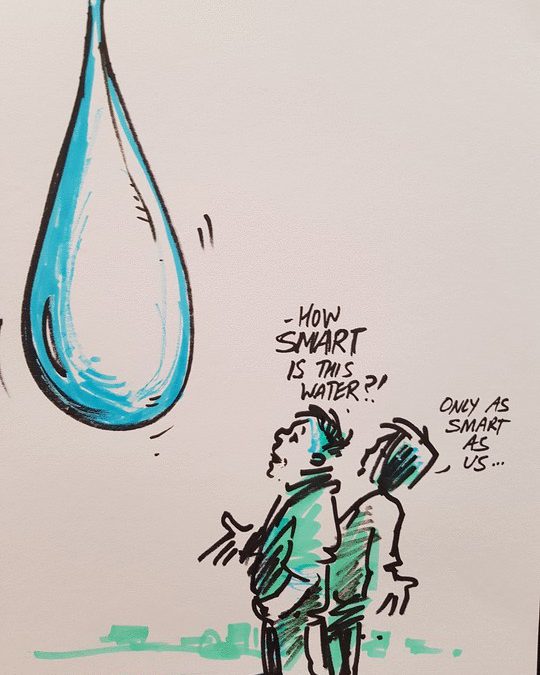
The Smart Water Summit 2018 was held in Adelaide from 22 to 23 March, hosted by the Water Industry Alliance and ICE WaRM.
My role was as the MC for the event, which had 29 speakers on the first day, with concurrent sessions for three hours, and two plenary sessions with panel discussions. You can see the full program here.
Smart Water was the title of the Summit, and was also the theme of many of the presentations. Water is getting more scarce, or too unpredictable, customers are getting more demanding, and the technology base is changing rapidly. Water businesses that thrive will be smarter in how they manage water, staff and technology to deliver benefits to their customers.
These are some of the key themes that I drew out from the day.
1. How we manage the interaction between humans and technology is going to be critically important, not just for the water industry, but for society more generally.

On the one hand, there is a drive to use technology to develop more human responsive systems, such as SA Water’s billing
On the other hand, there is a trend to automate existing processes run by humans!
There is more to learn about how we can best adapt our work environments to optimize this interaction, including better understanding the neuro-physiology of how we interact – Fiona Kerr.
There is clearly a role of policy and regulation to ensure an ethical approach to both of these trends, and it is an issue we will need to address in conversation with customers and governments over the next decade.
Clare Forbes from Deloittes presented some very challenging data that shows that the skills and confidence of workers is failing to keep up with perceived needs to address the demographic and technological changes hitting the workplace. Who is going to provide you with the training and staff development to enable your business to keep pace?
2. Data related to water may end up being worth more than the water itself!

David Garmen, CTO of The Water Council gave us examples of companies moving in to harvest, analyse and integrate data from cheap arrays of sensors within water supply and treatment systems.
Who will be best placed to harvest and analyse data from water supply and treatment systems to create new products, services and value for customers.
What is the potential for using this information for good and for evil. For example, will political parties be able to target political messages to us based on information they capture from our sewerage data! What can we learn about public health or security risks?
As systems become digitized and automated, the opportunity for integrating different management systems becomes greater. There is going to be a lucrative opportunity for the systems integrators, as presented by Dematec, to connect and optimize the systems that control and manage our water supply and treatment systems.
3. Future water businesses will change their focus
Water may not be the only product or service created or sold. Co-products may also include: Data, Energy, Liveability, Well-being and Health.

Building trust with customers is important if the water industry is going to be able to adopt new innovations and present new services and products. Water organisations like Sunshine Coast Water and SA Water are re-shaping their organisations and systems around customer needs: to maximise the positive experiences and minimizing the negative experiences. Interestingly, this is not just important for the customers, but also for the morale of staff in the organisation who are getting regular feedback on the performance of the organisation from their customers.
The work place of the water sector, like all work places, will need to be more innovative, which requires a change in the way we structure organisations and allow people to move across porous-boundaries.
4. There are huge global business opportunities for partnership with SA and Australian companies

We heard from Dean Amhausfrom The Water Council who presented a very exciting, industry driven and funded model of collaboration in the water industry for business development and innovation.
Dr Anthony Ma from the Hong Kong Productivity Councilpresented tangible examples of how South Australian businesses could engage in the delivery of solutions in partnership.
Clobe Ng from the Hong Kong Smart City Consortium is a gateway for Australian businesses into the massive One Belt One Road initiative in China.
The Sponge City Consortium identified that if you want to develop and succeed in these international partnerships, you must be prepared to travel, and must be prepared to invest time to build relationships.
Aither told us that valuing water explicitly improves decision making. Australia probably leads the world on valuing water. Tom Rooney told us that Waterfind are already exporting some of these tools to the world. What other opportunities are there for Australia to leverage its natural advantage?
5. Other countries are obviously investing in innovation in the water sector and they are better set up to do so. Can Australia keep up?

If so, how are we going to do it?
Who is going to drive new innovation in the sector and what will be the incentives for Australian businesses to take the risk?
Will the next generation of innovation come from water businesses with an interest in technology or tech businesses with an interest in water? If you are a water business with limited technological capabilities, who can you partner with to gain a globally leading advantage?
A common theme is that partnerships are going to be key for the water sector in the future. We all need to grow our skills in partnering for mutual benefit, to drive innovation and grow our businesses.
* Many thanks to Rachel Barratt from the Water Industry Alliance for inviting me to be a part of the day.
* The cartoons were drawn by Simon Kneebone on the day and remain the copyright of the Water Industry Alliance.