
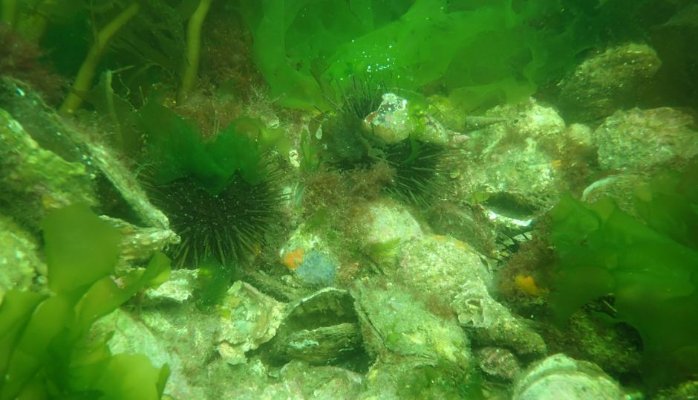
On 28th June 2016, the South Australian Minister for Environment, Ian Hunter, announced the construction of a new, four hectare, artificial shellfish reef, to be located south of Ardrossan. The reef will be accessible from several boat ramps in the area. The project is being led by PIRSA in collaboration with the Department of Environment, Water and Natural Resources (DEWNR), RecFish SA, other government agencies and community stakeholders.
The coastline of South Australia once had 1500 km of oyster reefs along its coastline. Heidi Alleway (Tall Poppy Award Winner) did a very clever piece of work at the University of Adelaide, piecing together historical evidence that showed that these oyster reefs existed and were completely fished out and removed between the late 1800s and early 1900s (Alleway and Connell, 2015).
These shellfish reefs likely played an important role in removing nutrients and sedimentation from coastal waters, provided habitat for marine life. By keeping the waters clean, this would have created the right conditions for seagrass habitat which again would have provided important habitat for marine life. Australia has a very poor record in this regard, with most of our oyster reefs functionally extinct (Figure 1).
Figure 1. Oyster reef condition across the world

The coast off of Australia was once teeming with fish (Figure 2). It supported many commercial fishermen. Recreational fishers caught large predatory fish off our beaches and jetties. Today, despite strict quotas and fisheries management, the coast of Australia has comparatively few fish to what it once supported. A lack of suitable habitat is likely to be inhibiting a recovery in fish population numbers.
Figure 2. Historic photos of large fish catches off the coast of South Australia

Fishing catch from Sellicks Beach, S. Aust., circa 1938 (photo courtesy of South Australian Library)

Fishing catch and fishermen John (Jack) Peter Graney and C. Pavy at Milang jetty 1928 (photo courtesy of South Australian Library)

A crowd watches a commercial fisher bring in a net at Port Noarlunga , 1938 (photo courtesy of South Australian Library)
Restoring shellfish reefs will recreate important habitat for fish along the coast of Australia that should lead to larger fish populations. These reefs will also help to clean up nutrients and sediment from some of the more polluted coastal areas. This initiative of the South Australian Government to re-establish a shellfish reef is most welcome and should be the start of a longer term commitment by government and communities to restore oyster and shellfish reefs right along our coasts.
The benefits to South Australia of this initiative will be more habitat for fish which will underpin our recreational fishing and tourism industries. For example, more than 277,000 people are involved in recreational fishing across South Australia. Each year, about one million visitors are attracted to Yorke Peninsula alone with about half of these visiting the region specifically to take part in recreational fishing. They will also help to stabilise sand and remove nutrients and sediment, encouraging other habitats and organisms to re-establish.
Increasing coastal fish populations by restoring shellfish reefs will be a long term investment in the health of the environment and economy of Australia.